Minnesota Home and Auto Insurance Costs: What's Driving Increases and How to Shop
Updated November 6, 2026
Updated October 2026
The short answer: Minnesota home and auto insurance costs have risen faster than the U.S. average since 2022, driven mostly by costly hail and windstorms, more expensive vehicle and home repairs, and insurers catching up after years of paying out more than they collected. Auto prices have started to ease; home prices are still settling. But no statewide average predicts your own bill, and the most useful thing you can do is compare policies with matching coverage, line by line.
This guide covers home and auto separately, because they are different products with different data and different causes. Each figure below comes with its source, period and what it actually measures, since a filed rate change, an average premium and a shopping quote are not the same thing.
What the recent numbers say
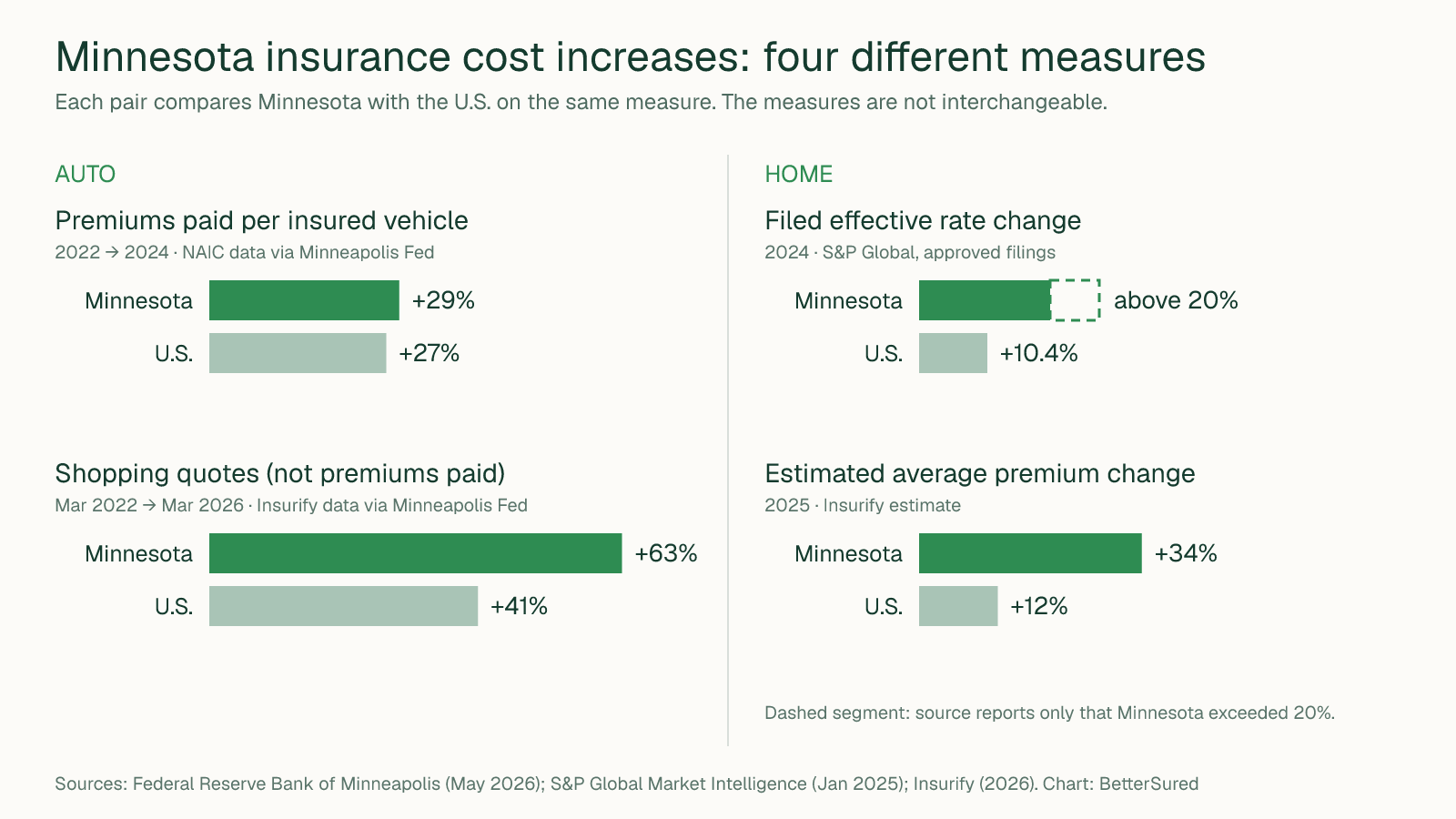
Four widely cited figures describe Minnesota's increases. The chart at the top of this page compares each with the national figure from the same source. They are useful together, but they should never be blended into one trend line.
| Measure | Period | Minnesota | U.S. | Source |
|---|---|---|---|---|
| Auto premiums earned per insured vehicle (premiums paid) | 2022–2024 | +29% | +27% | Minneapolis Fed, NAIC data |
| Auto shopping quotes (not premiums paid) | Mar 2022–Mar 2026 | +63% | +41% | Minneapolis Fed, Insurify data |
| Homeowners filed effective rate change | 2024 | Above 20% | +10.4% | S&P Global |
| Estimated average homeowners premium change | End of 2024–end of 2025 | +34% | +12% | Insurify |
How to read these figures
- Auto premiums per insured vehicle come from what insurers actually earned, as reported to the National Association of Insurance Commissioners (NAIC). The Minneapolis Fed found Minnesota's 29% increase from 2022 to 2024 was ninth highest among states. Expressed as an index, 2022 = 100 and 2024 = 129. This is the closest thing to "what drivers paid," but it lags; no 2025 figure was available at publication.
- Auto shopping quotes are more current but measure something different. According to the Fed's analysis of Insurify data, Minnesota quotes fell 11% in the year to March 2026, yet were still 63% above March 2022. The Fed cautions that quotes are not premiums paid, partly because people shopping around may be paying more than the typical driver.
- Filed effective rate changes describe what insurers got approved by regulators, weighted by market share. S&P Global's analysis of approved homeowners filings through late December 2024 placed Minnesota among the states above 20%, against a national weighted average of 10.4%. It covers each state's largest insurers, not every household, and the article does not state Minnesota's exact figure.
- Insurify's home estimate models the median cost of a standard HO-3 policy for a typical Minnesota home (about $407,000 of dwelling coverage), using its quote database and filed rates, with assumptions including a 2% hail deductible, no recent claims and good credit. By that method, Minnesota's average rose 34% in 2025 to about $3,530 a year, the largest increase of any state, per Insurify's 2026 report. It is a commercial estimate, not a state-reported figure.
None of these numbers tells you what your renewal should be. Your premium depends on your home or vehicles, address, coverage limits, deductibles, claims and credit history, and your insurer's own pricing. Our guide to why your Minnesota home insurance went up shows how to calculate your own change and compare it with these benchmarks.
Why Minnesota home insurance costs move
Hail and wind losses
Severe convective storms (hail, straight-line winds and tornadoes) are Minnesota's dominant homeowners risk. On May 19, 2022, a single storm dropped quarter- to golf-ball-sized hail across Minneapolis, St. Paul, the northern suburbs and central Washington County, with damage estimated at $2.6 billion as of October 2023, according to the Minnesota DNR. Insurify reports that Minnesota home insurers paid about $158 for every $100 of premium they collected in 2022, the kind of result that leads to large rate filings in the years that follow.
Rebuilding costs
Home premiums are tied to the cost of rebuilding, not the market value of the house. When materials and labor get more expensive, insurers raise dwelling limits and rates to match. If your dwelling limit went up at renewal, part of your higher premium may simply reflect more coverage.
Policy terms and deductibles
Some changes are not price increases at all, but changes in what the policy does. The Minnesota Department of Commerce has warned homeowners that some carriers now use separate wind and hail deductibles, sometimes a flat amount or 1% or more of the home's replacement value, and policy language that limits coverage for hail damage that does not puncture or tear roofing or siding. Read your renewal for these changes. Our guide to reviewing Minnesota wind and hail coverage explains what to look for.
Why Minnesota auto insurance costs move
The Minneapolis Fed identified three drivers behind Minnesota's steeper auto increases:
- Storm damage to vehicles. Nationally, liability coverage was the largest contributor to 2023 premium growth. In Minnesota, the largest was comprehensive coverage (which pays for hail and other non-collision damage), followed by collision. The National Weather Service logged 581 severe hail reports in Minnesota in 2022 and 350 in 2023, against a 10-year average of 301. With roughly 60% of the state's registered vehicles in the Twin Cities metro, a single metro hailstorm can damage a large share of insured cars.
- Repair costs. The average collision claim in Minnesota rose 23% in 2021 and 19% in 2022, outpacing national increases, as parts and body-shop labor got more expensive.
- Insurers catching up. Insurers initially treated rising repair costs as temporary, then raised rates sharply once losses persisted. In Minnesota, rate increases above 25% within 12 months are subject to a public hearing, which can lead insurers to spread increases over time.
For what each coverage does and what drivers can compare, see why Minnesota car insurance costs rose.
What Minnesota shoppers can do
- Compare identical coverage. A quote is only cheaper if the limits, deductibles and endorsements match. Start with your current declarations page and use it as the template for every quote. Our Twin Cities home insurance comparison worksheet lists the fields to line up.
- Inspect deductibles and exclusions. Look for a separate wind/hail deductible, how your roof is settled (replacement cost or actual cash value), and any cosmetic-damage language. A lower premium can come from shifting more storm risk to you.
- Ask about discounts, then check the total. Bundling home and auto, impact-resistant roofing, security devices and paying in full may lower the price. Compare a bundle as one total against the best separate policies; bundling does not always save.
- Weigh deductibles against your savings. A higher deductible lowers your premium, but only makes sense if you could comfortably pay it after a storm. See how deductibles work.
- Get a coverage review from a licensed professional. A Minnesota-licensed independent agent can compare several carriers and explain trade-offs you may not see on a quote.
Minnesota-specific questions
Why did Minnesota rates rise more than the national average?
The sources point mainly to storm losses concentrated in a dense metro area. Costly storms in 2022 and 2023 hit the Twin Cities, where most of the state's homes and vehicles are, and repair costs rose faster than average at the same time.
Are Minnesota insurance rates going down?
For auto, shopping quotes were falling as of March 2026, according to the Minneapolis Fed, though still well above 2022 levels. For home, Insurify projects a smaller increase of about 4% by the end of 2026, which is a forecast rather than a guarantee. Your own renewal may move differently.
Does Minnesota's no-fault law affect what I pay?
Every Minnesota auto policy must include personal injury protection (PIP), liability, and uninsured and underinsured motorist coverage, so the minimum policy is more than liability alone. Our Minnesota no-fault and PIP explainer covers what is required and what it pays.
Who can help if I have a problem with my insurer?
The Minnesota Department of Commerce Consumer Services Center takes questions and complaints at 651-539-1600 or 800-657-3602, and its claim guidance explains what to do in a dispute.
Minnesota insurance guides
- Why did my Minnesota home insurance go up? Data and a renewal checklist
- Twin Cities hail damage: home insurance terms to check before storm season
- Hail damage to your Minnesota home: how to document it and start a claim
- How to compare homeowners insurance in Minneapolis, St. Paul and nearby suburbs
- Condo and townhome insurance in Minnesota
- Why Minnesota car insurance costs rose, and what drivers can compare
- Minnesota no-fault auto insurance explained
- Minnesota winter car insurance: what covers a crash, deer strike or hail?
Compare quotes on equivalent coverage
If you want to check whether your current price is competitive, BetterSured lets you upload your declarations page so quotes are built on the same limits and deductibles you have now. Vetted local independent brokers then compete to quote that coverage. Brokers pay BetterSured to receive these requests, and your details are shared only with the brokers who quote you. Brokers may not represent every insurer, quotes are subject to each insurer's underwriting, and there is no guarantee of a lower price; sometimes the useful result is confirming your current policy is a good deal.
Methodology note: figures in this guide come from the sources linked beside them, which use different methods and periods. We compare Minnesota with the U.S. only within the same source and measure. Journalists and researchers are welcome to cite the chart and table with a link to this page.
Related guides