Why Minnesota Car Insurance Costs Rose—and What Drivers Can Compare
Updated November 6, 2026
Updated October 2026
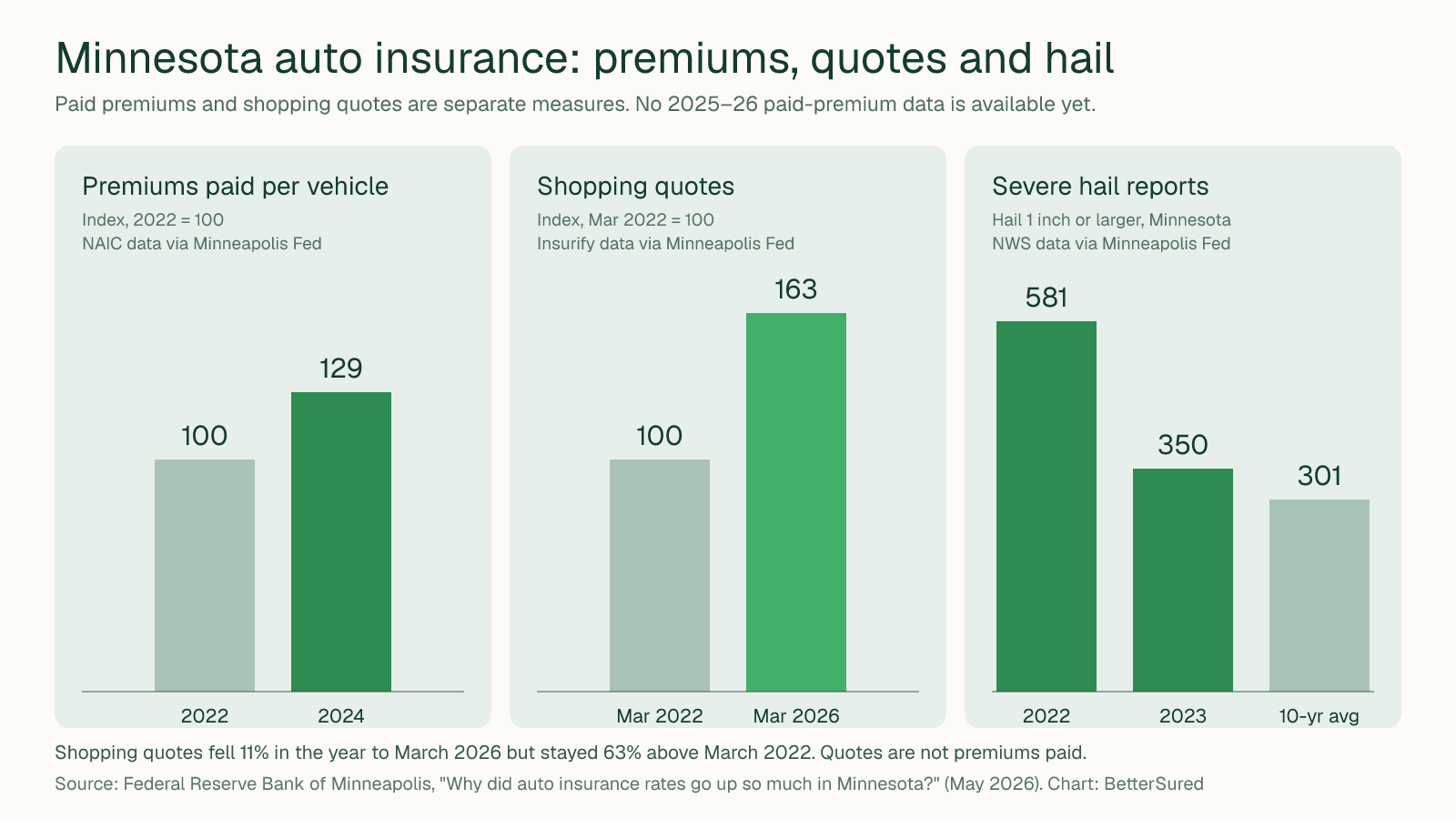
The short answer: Auto premiums paid per insured vehicle in Minnesota rose 29% from 2022 to 2024, a bit faster than the national 27%, according to the Federal Reserve Bank of Minneapolis. The main reasons were hail damage to vehicles, which shows up in comprehensive coverage, and sharply higher repair costs, which show up in collision. Shopping quotes have started falling but remain well above 2022 levels. The best response is to compare policies with identical limits and deductibles, and to check that your coverage still fits your car and your finances.
The Minnesota trend, and how it is measured
The chart at the top of this page shows three separate measures. Two describe cost; one describes the storms behind it.
| Measure | What it is | Minnesota | U.S. |
|---|---|---|---|
| Premiums earned per insured vehicle, 2022–2024 | What insurers actually collected (NAIC data). Index: 2022 = 100, 2024 = 129. | +29% (9th highest) | +27% |
| Shopping quotes, March 2022 to March 2026 | Insurify quotes. Not premiums paid; shoppers may skew toward higher-cost drivers. | +63% (but −11% in the latest year) | +41% (−6% in the latest year) |
| NAIC combined average premium, 2023 vs. 2022 | Sum of average premiums for each coverage type | +15% | +14% |
| Severe hail reports (hail 1 inch or larger) | National Weather Service counts | 581 in 2022; 350 in 2023; 10-year average 301 | — |
Source for all rows: Minneapolis Fed, May 2026. Paid-premium data for 2025 and 2026 were not yet available, so no paid-premium figures are shown for those years.
None of these predicts your premium, which depends on your drivers, vehicles, address, driving record, coverage choices and insurer.
What each part of your auto policy does
| Coverage | What it pays for | Required in Minnesota? |
|---|---|---|
| Liability (bodily injury and property damage) | Injuries and damage you cause to other people and their property | Yes |
| Personal injury protection (PIP, "no-fault") | Your and your passengers' medical costs, lost wages and some other losses, regardless of fault, up to its limits | Yes |
| Uninsured/underinsured motorist (UM/UIM) | Your injuries when the at-fault driver has no or too little insurance | Yes |
| Collision | Damage to your car from hitting another vehicle or object, or rolling over | No (lenders usually require it) |
| Comprehensive | Damage to your car from other causes, such as hail, hitting a deer, theft, fire or falling objects | No (lenders usually require it) |
Comprehensive and collision do not overlap: comprehensive does not pay for a crash into another car, and collision does not pay for hail. Each has its own deductible. For how PIP and liability interact, see our Minnesota no-fault and PIP explainer.
Why storms and repair costs drove Minnesota prices
Hail and comprehensive claims
Nationally, liability was the biggest contributor to 2023 premium growth. In Minnesota, the Fed found the biggest contributor was comprehensive coverage, followed by collision. Minnesota recorded far more severe hail in 2022 and 2023 than its 10-year average, and roughly 60% of the state's registered vehicles are in the Twin Cities metro, so a single metro storm can damage a large share of the state's insured cars. The May 2022 storm that crossed Minneapolis, St. Paul and the eastern suburbs is one example; our Twin Cities hail guide covers the home side of the same storms.
Parts and labor
The average collision claim in Minnesota rose 23% in 2021 and 19% in 2022, compared with 19% and 18% nationally. One difference the Fed points to is labor: Minnesota body-shop wages rose 16% in 2021, versus 4% nationally. Modern vehicles with sensors and cameras also cost more to repair after even minor damage.
Insurers catching up, then easing
Insurers initially treated rising repair costs as temporary and raised rates later, after heavy losses in 2022. In Minnesota, an increase of more than 25% in 12 months is subject to a public hearing, which the Fed notes can lead insurers to spread increases out. With competition and more customers shopping, quotes began falling by 2025–2026.
Which policy fields to compare
Quotes are only comparable if these match:
- Liability limits (for example 100/300/100), not just "full coverage"
- PIP and UM/UIM limits, including any optional higher amounts
- Collision and comprehensive deductibles, listed separately
- Drivers listed and who is the primary driver of each car
- Vehicles, by VIN, and whether each has collision and comprehensive
- Use and mileage: commuting distance, business use, annual miles
- Garaging address where the cars are kept overnight
- Add-ons: rental reimbursement, towing, glass, gap coverage
Legal minimum vs. what you may need
Minnesota's minimum is liability of $30,000 per person and $60,000 per accident for injuries and $10,000 for property damage, plus $40,000 of PIP per person ($20,000 medical and $20,000 non-medical) and uninsured and underinsured motorist coverage, according to the Minnesota Department of Commerce. A $10,000 property damage limit can be used up by a single newer vehicle, and anything above your limits can fall on you personally. Many drivers with savings or a home choose higher liability limits, and some add an umbrella policy.
On older cars, dropping collision or comprehensive can save money, but think about whether you could replace the car after a hailstorm or deer strike without it.
Minnesota auto shopping checklist
| Done | Step |
|---|---|
| ☐ | Pull your current declarations page and note every limit and deductible |
| ☐ | Decide whether your liability limits still fit your assets |
| ☐ | Check comprehensive deductible against hail risk and your savings |
| ☐ | Confirm drivers, vehicles, mileage and garaging address are accurate |
| ☐ | Ask about discounts (bundling, multi-car, safe driver, usage-based programs) |
| ☐ | Get quotes with identical limits and deductibles, then compare total price |
Usage-based programs can help some drivers; see what telematics really saves. For winter incidents, our guide to which coverage applies to an icy crash, deer strike or hail may help.
Related Minnesota guides
- Minnesota home and auto insurance cost guide
- Minnesota no-fault auto insurance explained
- Minnesota winter car insurance: what covers a crash, deer strike or hail?
Compare auto quotes on equivalent coverage
BetterSured reads the declarations page you upload so quotes match your current limits and deductibles, then vetted local independent brokers compete to quote that coverage. It is built mainly for households bundling auto with home or umbrella coverage. Brokers pay BetterSured for these requests, your details go only to the brokers who quote you, quotes depend on each insurer's underwriting, and a lower price is not guaranteed.
Related guides