How to Compare Homeowners Insurance in Minneapolis, St. Paul, and Nearby Suburbs
Updated November 6, 2026
Updated October 2026
The short answer: To compare homeowners insurance fairly in Minneapolis, St. Paul or the suburbs, make every quote match your chosen coverage first: dwelling limit, personal property, liability, both deductibles, roof settlement and water backup. Only then compare the annual premium. A quote that looks cheaper often has a higher wind/hail deductible or pays less for your roof. This guide is a comparison framework, not a ranking of suburbs or insurers.
Why matching terms matters
Minnesota homeowners policies vary more than they used to. The Minnesota Department of Commerce has warned that some insurers now use separate wind and hail deductibles and language that limits coverage for cosmetic hail damage. Two quotes with the same dwelling limit can leave you with very different bills after a hailstorm. Lining up the terms is how you tell a lower price from less coverage.
The comparison worksheet
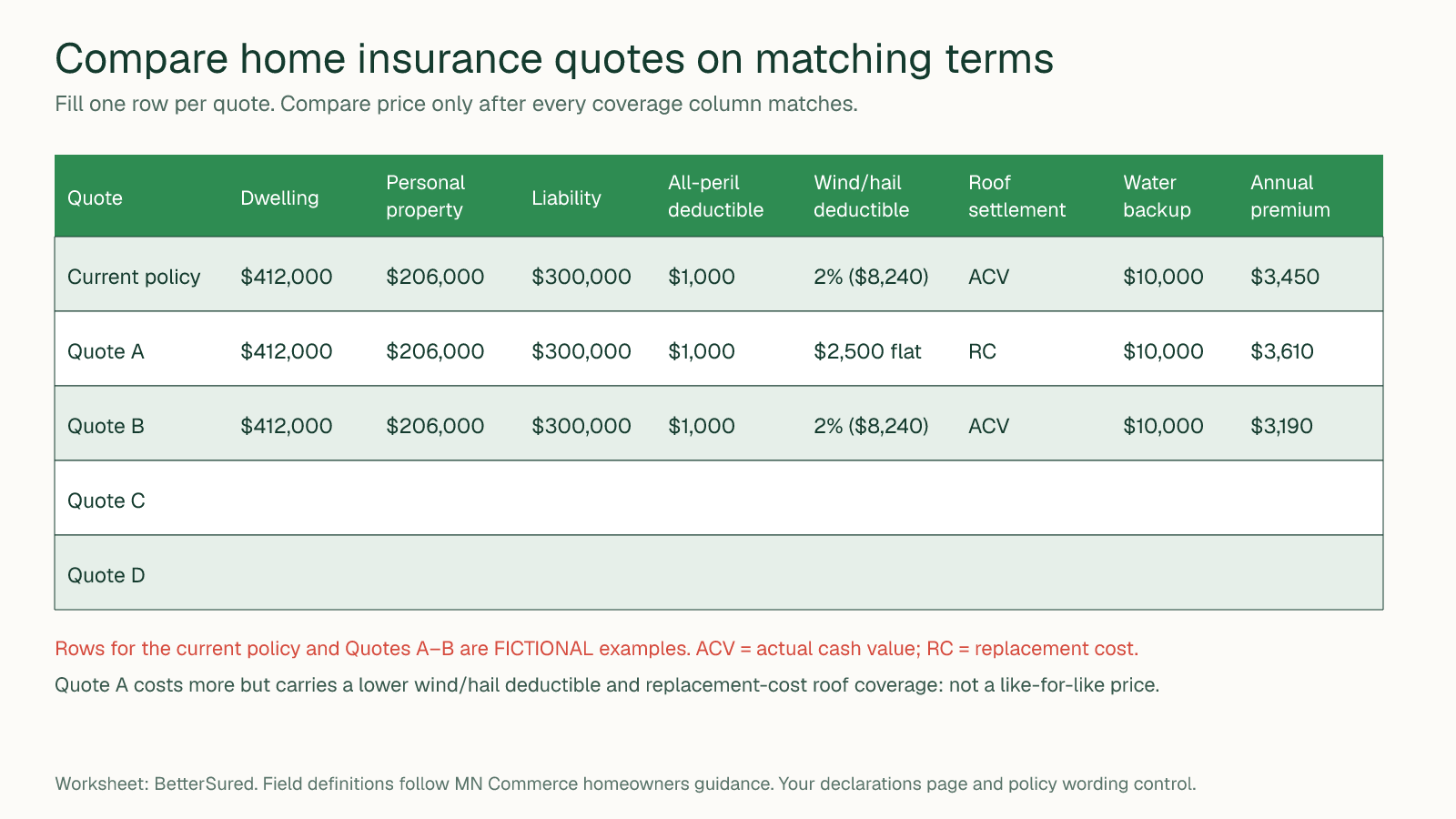
The worksheet at the top of this page shows the layout. Below is the same worksheet as a table you can copy, print or share. The filled rows are fictional examples.
| Quote | Dwelling | Personal property | Liability | All-peril deductible | Wind/hail deductible | Roof settlement | Water backup | Annual premium |
|---|---|---|---|---|---|---|---|---|
| Current policy (example) | $412,000 | $206,000 | $300,000 | $1,000 | 2% ($8,240) | Actual cash value | $10,000 | $3,450 |
| Quote A (example) | $412,000 | $206,000 | $300,000 | $1,000 | $2,500 flat | Replacement cost | $10,000 | $3,610 |
| Quote B (example) | $412,000 | $206,000 | $300,000 | $1,000 | 2% ($8,240) | Actual cash value | $10,000 | $3,190 |
| Quote C | ||||||||
| Quote D |
In this example, Quote B is the like-for-like comparison with the current policy and is $260 cheaper. Quote A costs more, but it is not comparable: it has a lower wind/hail deductible and pays replacement cost for the roof, which could matter a lot after a storm.
Dwelling limit vs. market value
Your dwelling limit (Coverage A) should reflect what it would cost to rebuild your home, not its sale price or tax value. Land does not burn down, so rebuild cost can be lower than market value; but for some homes it is higher. The Department of Commerce notes that some older homes have architectural features that make replacement cost significantly higher than market value. That is worth keeping in mind for the many older homes in Minneapolis and St. Paul, with plaster walls, built-ins or woodwork that is costly to reproduce. Ask each insurer how it calculated the dwelling limit, and make sure all quotes use the same figure.
Standard vs. optional protections
- Standard in most HO-3 policies: the dwelling, other structures such as a detached garage, personal property, loss of use and personal liability. Commerce describes the HO-3 as the most widely sold policy, covering most causes of loss except those excluded.
- Often optional or limited: water or sewer backup, higher limits for jewelry and valuables, ordinance or law coverage for code upgrades, and replacement cost for personal property.
- Not covered by standard policies: flood, which requires a separate policy, and earthquake.
Water backup from a sump pump or sewer line is a common Twin Cities basement claim. If you have a finished basement, compare that limit carefully. Our explainer on water damage vs. flood insurance covers the difference.
Deductible trade-offs
Higher deductibles lower premiums but raise what you pay after a claim. In Minnesota, look at two numbers: the all-other-perils deductible and any separate wind/hail deductible. A 2% wind/hail deductible on a $412,000 dwelling limit is $8,240. Choose amounts you could pay from savings after a storm. For a deeper look, see what a deductible means.
Roof terms
Ask every insurer the same question: if hail damaged my roof tomorrow, would you pay replacement cost or actual cash value, and is there a cosmetic-damage exclusion? Our Twin Cities hail coverage guide explains these terms.
Questions to ask about discounts
- Is there a discount for bundling home and auto? What is each policy's price on its own?
- Do you credit an impact-resistant roof, a newer roof, monitored alarms or water-leak sensors?
- Is there a claims-free, paid-in-full or automatic-payment discount?
- Which discounts could change at renewal?
Bundling is worth checking but does not always save. Compare the bundle total with the best separate policies.
A note on Minneapolis, St. Paul and suburban prices
Prices do vary by location within the metro, but we have not seen a transparent, large enough dataset to rank Twin Cities suburbs fairly, so we don't. The only reliable way to know your price is to get quotes for your address with matching coverage.
When a licensed agent's advice helps
A Minnesota-licensed independent agent can help if your home is older or unusual, you have had recent claims, you received a non-renewal, or you are unsure how to set your dwelling limit. If you have a condo or townhome, see our guide to what the association policy may not cover first.
Related Minnesota guides
- Minnesota home and auto insurance cost guide
- Why did my Minnesota home insurance go up?
- Twin Cities hail damage: home insurance terms to check
Compare quotes using the same limits and deductibles
BetterSured does the matching step for you: upload your declarations page and it reads your current limits and deductibles, then vetted local independent brokers compete to quote that same coverage. Brokers pay BetterSured for these requests, and your details go only to the brokers who quote you. Brokers may not represent every insurer, quotes depend on underwriting, and a lower price is not guaranteed. Use the worksheet above to check every quote you receive, from any source.
Related guides