Condo and Townhome Insurance in Minnesota: What the Association Policy May Not Cover
Updated November 6, 2026
Updated October 2026. General information; your association's documents and your policy control.
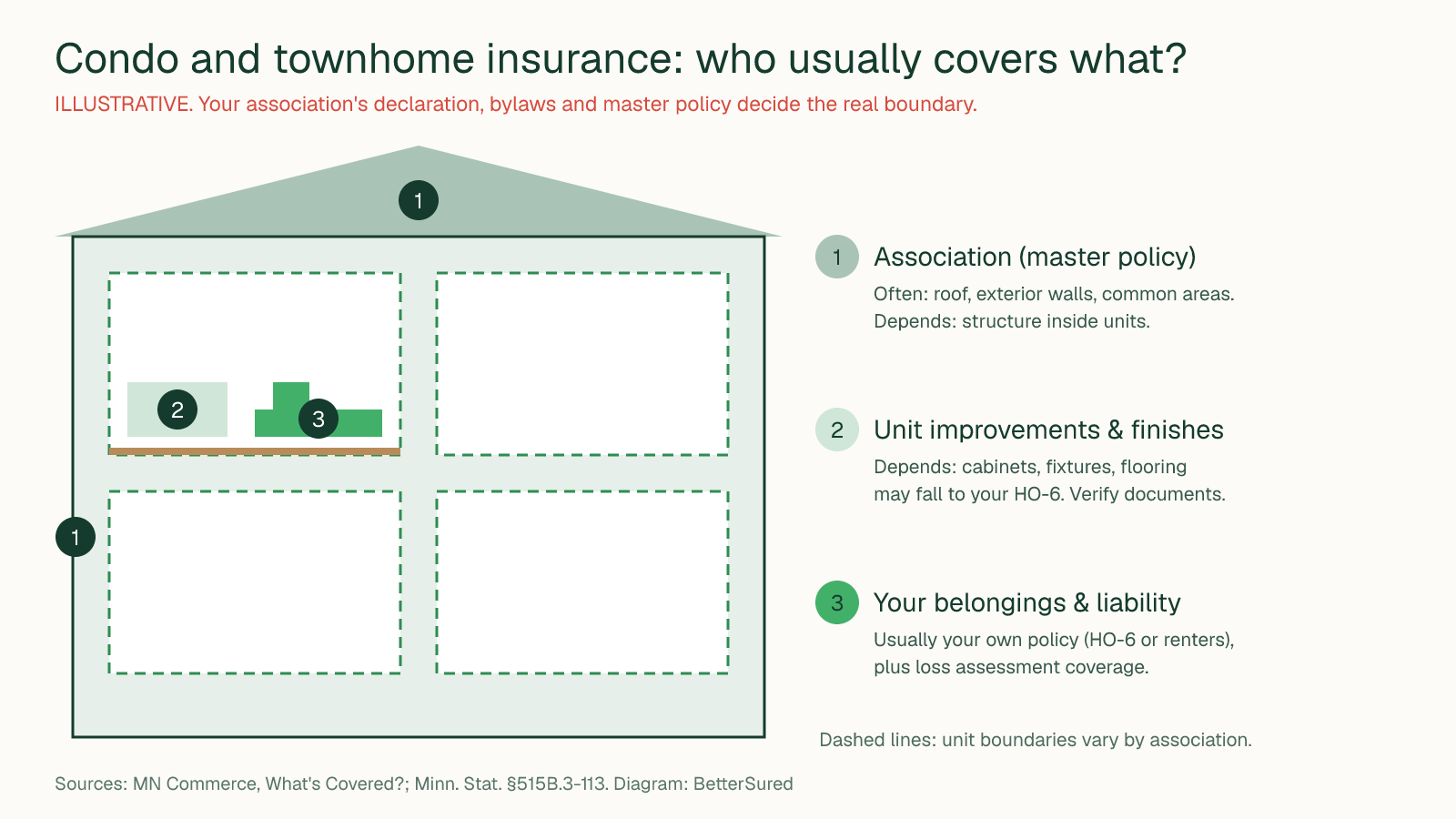
The short answer: In a Minnesota condo or townhome association, the association's master policy usually insures the building's structure and common areas, while your own policy (often an HO-6 for condos) covers your belongings, your liability and, frequently, the finishes inside your unit. Minnesota law allows associations to leave interior finishes, such as cabinets, flooring and fixtures, out of the master policy and to pass the master policy's deductible on to the owners whose units were damaged. Where the line falls depends on your association's declaration, bylaws and master policy, so read those before choosing coverage.
What the association policy generally protects
The Minnesota Department of Commerce explains that the condominium association buys insurance on the building and other structures, and that typically the association's insurance covers only the exterior walls, so items like bathroom fixtures, kitchen cabinets and carpet need to be covered by the owner's policy. Commerce advises checking with your association to confirm the extent of its coverage.
For associations governed by the Minnesota Common Interest Ownership Act, which covers many Minnesota condo and townhome communities, Minn. Stat. §515B.3-113 sets the baseline:
- The association must insure the common elements for their full insurable replacement cost, to the extent coverage is reasonably available.
- Where units share walls, siding or roofs, the association's policy must also cover the units themselves.
- The policy does not have to cover ceiling and wall finishes, finished flooring, cabinetry, finished millwork, fixtures and equipment serving a single unit, built-in appliances, or other improvements and betterments, whenever they were installed.
- When an owner has other insurance on the same property, the association's policy is primary.
Some townhome communities, especially those with detached or separately owned buildings, make each owner responsible for insuring their own structure. Only your declaration can tell you which setup you have.
Who usually covers what
The diagram at the top of this page shows the general pattern. In text form:
| Part of the property | Usually covered by | Status |
|---|---|---|
| Roof, exterior walls, common hallways, shared amenities | Association master policy | Often |
| Structure inside units (framing, drywall) | Association, or owner in some communities | Depends: verify documents |
| Cabinets, flooring, fixtures, built-in appliances, millwork | Often the owner's policy; Minnesota law lets associations exclude them | Depends: verify documents |
| Upgrades you or a previous owner made | Often the owner's policy | Depends: verify documents |
| Furniture, clothing, electronics and other belongings | Owner's policy | Usually |
| Liability for injuries inside your unit | Owner's policy | Usually |
| Your share of the association's deductible or uninsured losses | Owner's policy, through loss assessment coverage | Depends on your policy |
Your unit-owner policy
Commerce describes a condo owner's policy as similar to a renter's policy, mainly covering personal property and liability. In practice, most owners also need:
- Personal property for everything you own, ideally at replacement cost
- Dwelling or "improvements and betterments" coverage for finishes and fixtures the master policy leaves to you
- Personal liability for injuries to guests and damage you cause to other units, such as an overflowing tub leaking downstairs
- Loss of use if you can't live in the unit during repairs
- Loss assessment coverage for your share of association costs
Deductibles and loss assessments
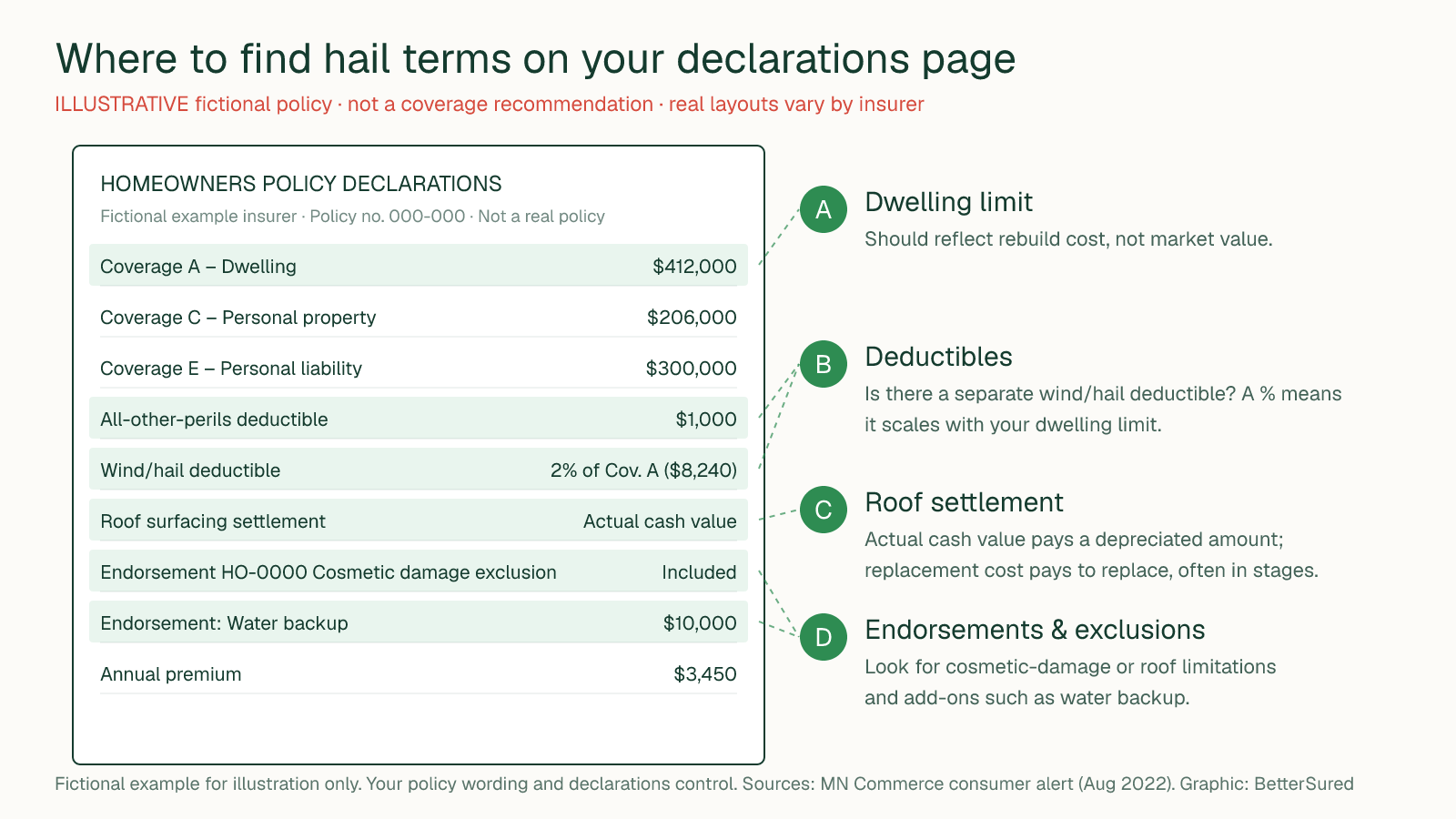
Master policies often carry large deductibles, sometimes with a separate wind/hail deductible after Twin Cities storms. Under §515B.3-113, for damage to a unit the association may pay the deductible as a common expense, assess it against the affected units in any reasonable manner, or require affected owners to pay it directly. The statute sets no dollar cap. If the association charges you, loss assessment coverage on your own policy may help, up to its limit. Our guide to loss assessment coverage explains how to size it.
Ask your association: How large is the master policy deductible, including any wind/hail deductible? How does the board allocate it? Then make sure your loss assessment and improvements coverage could absorb that amount.
Water damage and improvements
Water is where condo and townhome disputes most often start: a burst pipe, a failed water heater or a leak from the unit above. Whether the master policy, your policy or a neighbor's policy pays can depend on where the water came from, what was damaged and what your documents say. Ask whether your policy includes water or sewer backup coverage, which is often an add-on, and keep records of any upgrades you have made so you can show what needs insuring.
Documents to request: owner and board checklist
Free for associations and housing counselors to share, with credit to BetterSured. This list helps you ask the right questions; it does not replace your governing documents or professional advice.
| Done | Document or question |
|---|---|
| ☐ | Declaration: which parts of the building are the unit and which are common elements? |
| ☐ | Bylaws and rules: who insures and repairs what after a loss? |
| ☐ | Master policy certificate or summary: limits, coverage form and deductibles (all-peril and wind/hail) |
| ☐ | Does the master policy include or exclude interior finishes and improvements? |
| ☐ | Board policy on allocating the deductible to owners |
| ☐ | Any recent or planned special assessments |
| ☐ | Your own declarations page: improvements, personal property, liability and loss assessment limits |
After hail or another storm
Report damage to both your association and your own insurer, and document what you can from the ground. Our hail claim guide walks through the steps.
If you rent a condo or townhome
Renters need their own policy for belongings and liability; neither the owner's nor the association's insurance covers a tenant's things. Commerce notes a standard renter's policy insures personal property against a list of named perils and includes liability coverage. See our renters insurance guides.
Related Minnesota guides
- Minnesota home and auto insurance cost guide
- How to compare homeowners insurance in the Twin Cities
- Twin Cities hail damage: insurance terms to check
Compare condo or townhome coverage
Once you know what your association covers, compare unit-owner policies with the same improvements, personal property, liability and loss assessment limits. BetterSured reads the declarations page you upload so quotes match your current coverage, then vetted local independent brokers compete to quote it. Brokers pay BetterSured for these requests, your details go only to the brokers who quote you, and a lower price is not guaranteed. An agent can also help you match your coverage to your association's documents.
Related guides
Water Damage vs. Flood Insurance: What Your Standard Home Policy Covers
Actual Cash Value vs. Replacement Cost: Understanding Your Property Coverage
Condo Insurance (HO-6) vs. HOA Master Policy: What Coverage Do You Actually Need?
Twin Cities Hail Damage: Check These Home Insurance Terms Before Storm Season