Minnesota No-Fault Auto Insurance Explained: PIP, Minimums, and What It Covers
Updated November 6, 2026
Updated October 2026. General information, not legal advice.
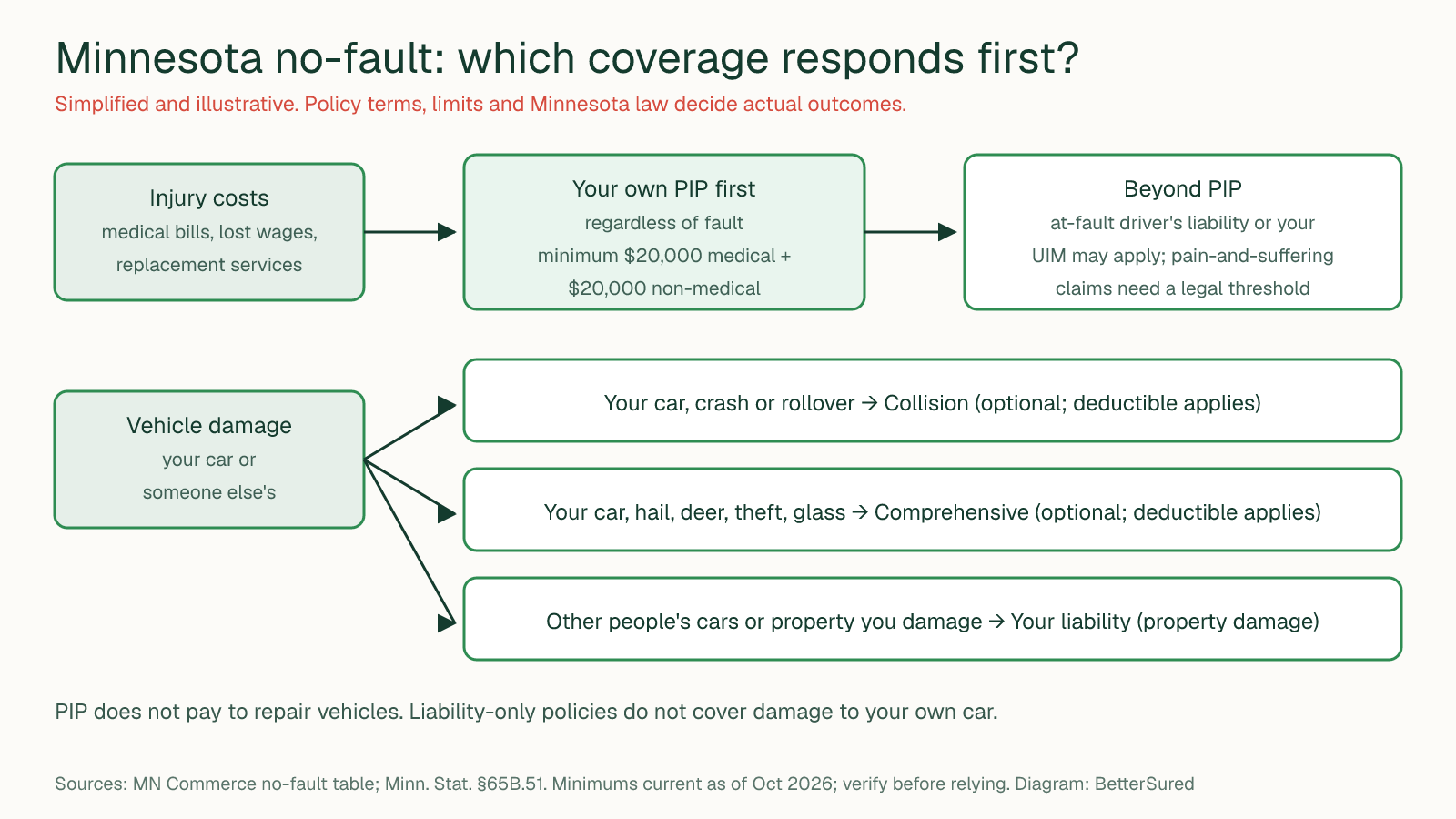
The short answer: In Minnesota, "no-fault" refers to personal injury protection (PIP): coverage on your own policy that pays your medical bills, lost wages and certain other injury-related costs after a car accident, no matter who caused it, up to its limits. The minimum is $40,000 per person: $20,000 for medical expenses and $20,000 for non-medical losses. No-fault does not cover vehicle damage, and fault still matters for property damage, for losses above your PIP limits and for claims against the at-fault driver once legal thresholds are met.
What "no-fault" actually means
Under the Minnesota No-Fault Automobile Insurance Act, your first source of payment for your own accident injuries is your own PIP coverage, not the other driver's insurer. That gets medical bills and lost income paid faster, without first deciding who was to blame.
Two common misunderstandings:
- "Fault doesn't matter." It does. Fault decides whose liability coverage pays for damaged vehicles and property, can affect your future premiums, and determines whether an injured person can recover from the at-fault driver beyond PIP.
- "No-fault covers everything." It doesn't. PIP has limits and covers injury-related costs only. Damage to your car needs collision or comprehensive coverage.
Required coverage in Minnesota
| Coverage | Minimum | What it does |
|---|---|---|
| Personal injury protection (PIP) | $40,000 per person per accident: $20,000 medical, $20,000 non-medical | Your and your passengers' injury costs, regardless of fault |
| Bodily injury liability | $30,000 per person / $60,000 per accident | Injuries you cause to others |
| Property damage liability | $10,000 per accident | Damage you cause to others' vehicles and property |
| Uninsured motorist | $25,000 per person / $50,000 per accident | Your injuries caused by a driver with no insurance |
| Underinsured motorist | $25,000 per person / $50,000 per accident | Your injuries when the at-fault driver's limits are too low |
Source: Minnesota Department of Commerce no-fault/PIP table; see also Commerce's auto insurance basics. Verify current amounts before relying on them; the Legislature can change them.
What PIP can pay
- Medical expenses (up to the $20,000 medical portion at minimum limits): hospital, doctor, therapy and similar reasonable care.
- Non-medical losses (up to the $20,000 non-medical portion): lost income, replacement services such as help with household tasks you can't do, and, according to Commerce, up to $2,000 for funeral expenses. Weekly caps and waiting periods apply to some of these, so check your policy.
The medical and non-medical amounts are separate pools. Running out of one does not let you borrow from the other. You can buy higher PIP limits.
What PIP does not cover
- Damage to your car or anyone else's vehicle or property
- Pain and suffering and other non-economic damages
- Costs above your PIP limits
Vehicle damage is a separate question
The diagram at the top of this page shows the split. For vehicles, which policy pays depends on what happened and who was at fault:
- Collision (optional) pays for your car after a crash or rollover, minus your deductible.
- Comprehensive (optional) pays for your car after hail, a deer strike, theft or similar events, minus your deductible.
- Property damage liability pays for others' vehicles and property that you damage. The other driver's liability may pay for your car if they caused the crash.
When the other driver's liability comes into play
If your losses exceed what PIP pays, an injured person may seek the uncovered economic loss from the at-fault driver. To recover non-economic damages such as pain and suffering, Minnesota law requires that the injury meet a threshold. Under Minn. Stat. §65B.51, that generally means medical expenses above $4,000 (with certain costs, such as diagnostic X-rays, excluded), or an injury causing permanent disfigurement, permanent injury, death or disability of 60 days or more. These rules have details and exceptions; an attorney can tell you how they apply to a specific case.
Simple scenarios (illustrative only)
| What happens | Injuries | Vehicle damage |
|---|---|---|
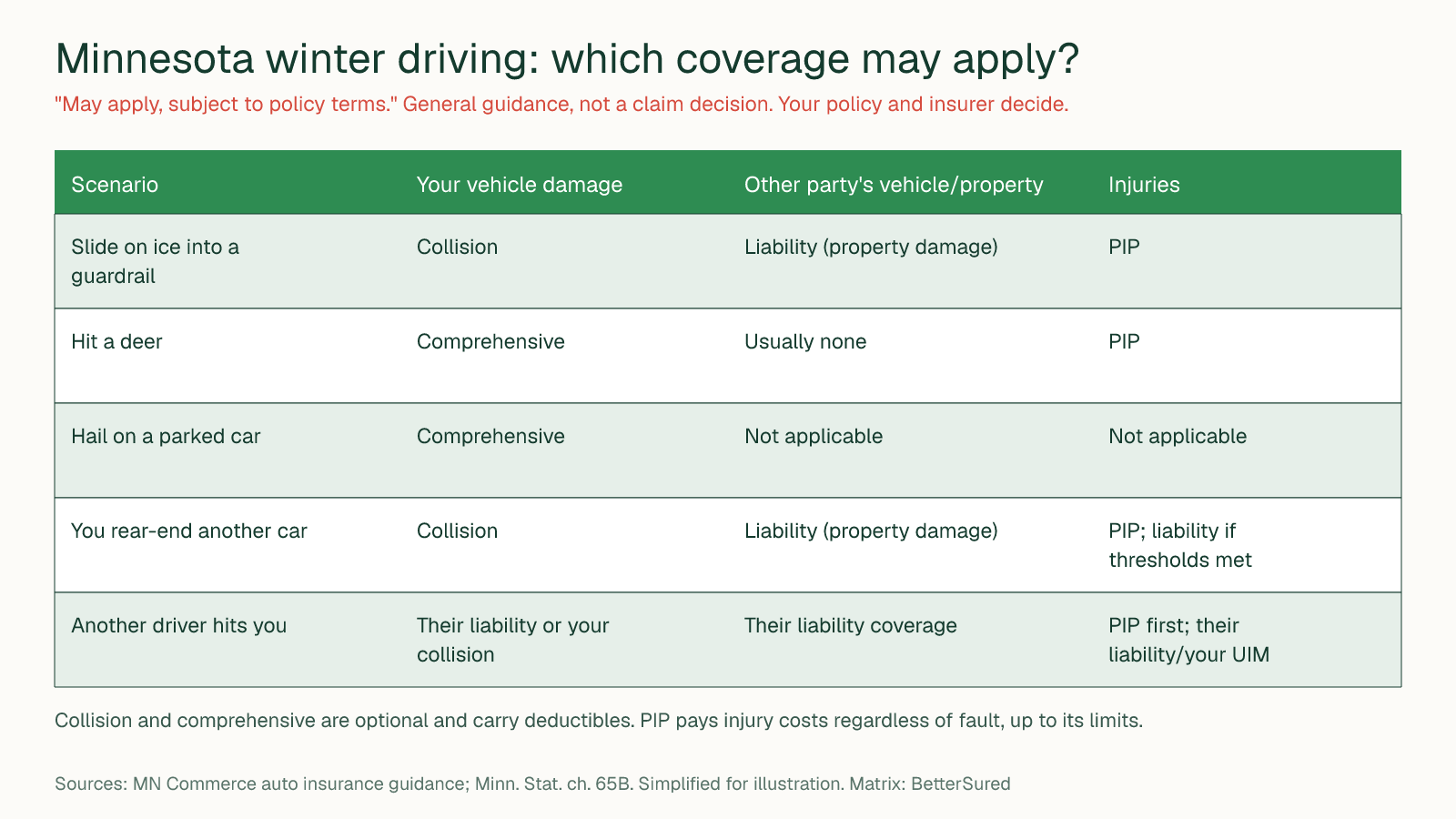
| Another driver runs a red light and hits you; you have $6,000 in medical bills | Your PIP first; the other driver's liability may cover more if the threshold is met | The other driver's property damage liability, or your collision (minus deductible) |
| You slide on ice into a parked car; your passenger is hurt | Your PIP covers your passenger's injury costs up to its limits | Your property damage liability for the parked car; your collision for your car |
| A hailstorm dents your parked car | None | Your comprehensive (minus deductible); PIP does not apply |
Our Minnesota winter driving scenarios walk through more examples.
Questions to ask when choosing limits
- Would $20,000 of medical coverage be enough after a serious injury? What does your health plan cover after a car accident?
- How long could you go without income? Would the non-medical portion cover it?
- Do your liability limits protect your savings and home? The $10,000 property damage minimum may not cover one newer vehicle.
- Would $25,000 of underinsured motorist coverage be enough if a minimum-limits driver injured you?
- Do you need collision and comprehensive for your car's value and your budget?
Minnesota auto coverage terms: printable glossary
Free for libraries, driver education programs and financial counselors to print and share, with credit to BetterSured.
| Term | Plain-language meaning |
|---|---|
| No-fault | Minnesota's system in which your own PIP pays your injury costs first, regardless of who caused the crash |
| PIP (personal injury protection) | Required coverage for medical and non-medical losses from injuries; minimum $40,000 per person |
| Basic economic loss benefits | The legal term for the PIP benefits the No-Fault Act requires |
| Liability | Pays for injuries and damage you cause to others, up to your limits |
| 30/60/10 | Minimum liability: $30,000 per injured person, $60,000 per accident, $10,000 property damage |
| Uninsured motorist (UM) | Pays your injury costs when the at-fault driver has no insurance |
| Underinsured motorist (UIM) | Pays when the at-fault driver's limits are too low to cover your injuries |
| Collision | Optional; pays for damage to your car from a crash or rollover |
| Comprehensive | Optional; pays for damage to your car from hail, deer, theft, fire and similar events |
| Deductible | The amount you pay before collision or comprehensive pays |
| Tort threshold | Conditions in §65B.51 that must be met before suing for pain and suffering |
Related Minnesota guides
- Minnesota home and auto insurance cost guide
- Why Minnesota car insurance costs rose, and what drivers can compare
- Minnesota winter car insurance: what covers a crash, deer strike or hail?
Compare auto quotes with the same limits
When you compare quotes, make sure PIP, liability and UM/UIM limits match, not just the price. BetterSured reads the declarations page you upload so quotes are built on your current limits, then vetted local independent brokers compete to quote that coverage. Brokers pay BetterSured for these requests, your details go only to the brokers who quote you, and a lower price is not guaranteed.
Related guides
Inflation Guard Endorsement: Protecting Your Home Against Rising Rebuild Costs
Minnesota Winter Car Insurance: What Covers a Crash, Deer Strike, or Hail Damage?
What Is Loss Assessment Coverage? Protecting Yourself from HOA Special Assessments
Does Getting a Dog Raise Your Home Insurance? What Dog Owners Should Know