Condo Insurance (HO-6) vs. HOA Master Policy: What Coverage Do You Actually Need?
Updated November 6, 2026
Condo insurance is one of the best deals in personal coverage. The average HO-6 policy runs about $490 a year, roughly $40 a month, according to a 2026 NerdWallet analysis of pricing from more than 100 insurers (NerdWallet, 2026). That is a fraction of what a single-family homeowners policy costs, because your homeowners association already insures the building.
The trouble is knowing exactly where the association's protection stops and yours has to start. Guess wrong and you can end up personally on the hook for your own drywall, your belongings, or a five-figure special assessment. Here is how the two policies fit together.
How the two policies split the risk
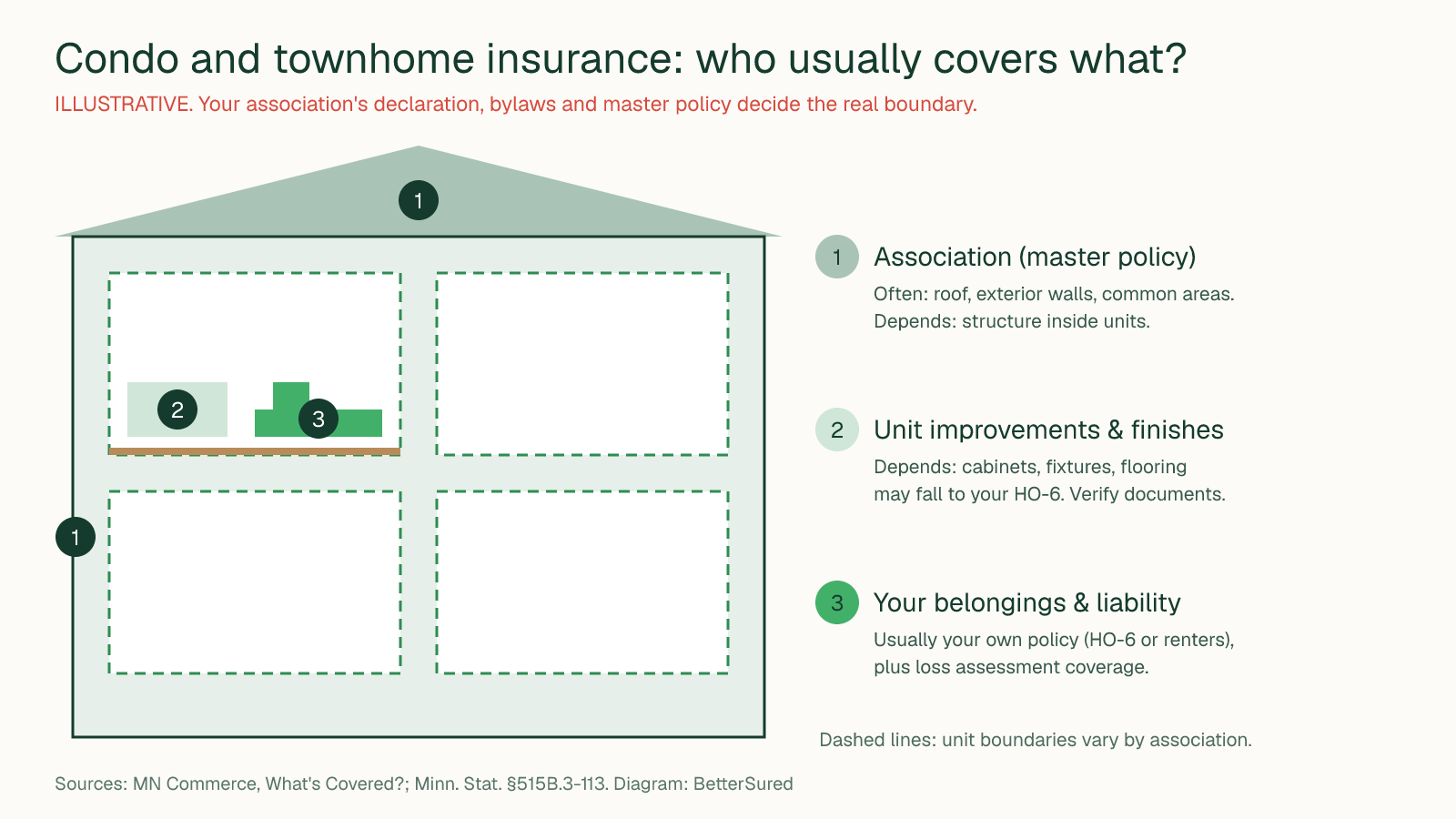
Think of your condo as two properties stacked on top of each other. The HOA master policy insures the shared structure and common areas: the roof, exterior walls, hallways, elevators, the pool, and usually the bare structure of your unit. Your HO-6 condo policy covers everything the master policy leaves to you: the interior build-out, your personal property, your liability, and the cost of living elsewhere if your unit becomes unlivable.
The exact dividing line is not universal. It is written in your association's governing documents and depends on which of three master policy types your building carries. Read those before you assume anything.
The three HOA master policy types
Master policies fall into three broad structures, and the difference between them can be tens of thousands of dollars in your pocket.
Bare walls-in
The most owner-unfriendly of the three. The association insures the structure up to the unfinished interior surfaces, essentially the studs, subfloor, and bare concrete. Everything past that point, drywall, flooring, cabinets, fixtures, appliances, is yours to insure. If a burst pipe destroys your kitchen, your HO-6 pays to rebuild it, not the master policy.
Single entity (also called original specifications)
The master policy covers the unit as it was originally built, including standard-grade finishes, but not upgrades a current or prior owner added. If your unit came with builder-grade laminate and someone later installed quartz counters and hardwood floors, those upgrades fall to your HO-6.
All-in (all-inclusive)
The most generous type. The master policy covers the unit's fixtures and finishes, including many upgrades, leaving your HO-6 to focus on personal property, liability, and assessments. You still need an HO-6, just often with a smaller dwelling limit.
What your HO-6 actually covers
A condo policy has five moving parts. Know what each one does before you pick limits.
- Dwelling (Coverage A): The "walls-in" build-out, drywall, flooring, cabinets, built-in appliances, and fixtures the master policy does not. This is the limit condo owners most often get wrong.
- Personal property (Coverage C): Your furniture, clothing, electronics, and everything you would take if you moved. Decide whether you want replacement cost or actual cash value, because the difference matters when you file a claim. Our guide to actual cash value vs. replacement cost breaks down why.
- Personal liability (Coverage E): Pays if someone is injured in your unit or you accidentally damage a neighbor's property, plus your legal defense.
- Loss of use (Coverage D): Covers hotel bills and extra living costs if a covered loss makes your unit uninhabitable.
- Loss assessment: Steps in when the association bills every owner a share of a covered loss that exceeds the master policy or its deductible. This is the coverage most owners underbuy.
Why loss assessment coverage matters
More than 370,000 U.S. homeowners associations now cover over 40 million households, more than half of all owner-occupied homes, and master policy deductibles have climbed steeply (USI, 2025). When a shared-property claim lands, two things can trigger a bill to every owner: the loss exceeds the master policy's limit, or the association passes its deductible along to unit owners.
Say a fire causes $150,000 of damage to a building whose master policy has a $100,000 limit and a $10,000 deductible spread across 20 units. Each owner could be assessed several thousand dollars, and your loss assessment coverage is what pays that share. The catch: most HO-6 policies include only about $1,000 of loss assessment coverage by default, though you can raise it to $50,000 or $100,000 with an inexpensive endorsement (USI, 2025). Insurify notes carriers commonly offer limits ranging from $10,000 to $100,000 (Insurify, 2025). It is worth understanding how loss assessment coverage works before you set that limit.
Who covers what: HOA master vs. HO-6
The chart below shows a typical split. Yours may differ depending on your master policy type, which is why the declarations page and bylaws are the final word.
| Item | HOA master policy | Your HO-6 policy |
|---|---|---|
| Roof and exterior walls | Yes | No |
| Common areas (halls, pool, elevator) | Yes | No |
| Bare structure of your unit (studs, subfloor) | Usually | No |
| Interior walls-in build-out (drywall, floors, cabinets) | Only if all-in / single entity | Yes (esp. bare walls-in) |
| Your belongings | No | Yes |
| Personal liability | Common areas only | Yes (inside your unit) |
| Living costs if unit is unlivable | No | Yes |
| Special assessment for a shared loss | No (it bills you) | Yes (loss assessment) |
Source: BetterSured summary of standard HOA master and HO-6 policy structures, 2026. Confirm details on your own master policy declarations page.
How to set your HO-6 dwelling limit
Your dwelling (Coverage A) limit should equal what it would cost to rebuild your interior from the bare studs in, not your unit's market value and not what the master policy insures. Work through it like this:
- Confirm your master policy type. Bare walls-in means you insure all interior finishes; all-in means far less.
- Inventory your build-out, flooring, cabinetry, countertops, built-in appliances, light and plumbing fixtures, and any upgrades you or a prior owner made.
- Estimate replacement cost per square foot for those finishes, then multiply by your interior square footage. A contractor or your agent can help benchmark this.
- Add a cushion for higher-end upgrades. Underinsuring here is the single most common HO-6 mistake.
Also decide your out-of-pocket comfort level, since a lower deductible raises your premium and a higher one lowers it. And know that standard policies exclude flooding, so if your building sits in a flood-prone area, review the difference between home water damage and flood insurance.
Read the bylaws before you buy
Before you set a single limit, get two documents from your association: the master policy declarations page and the bylaws or CC&Rs (the covenants, conditions, and restrictions). The declarations page tells you the master policy's limit and deductible. The bylaws spell out exactly where the association's responsibility ends and yours begins, using that walls-in, single entity, or all-in language.
- Note the master policy deductible, especially any separate wind, hail, or water deductible that can be passed to owners.
- Check whether the master policy is bare walls-in, single entity, or all-in.
- Confirm whether upgrades and betterments are the owner's responsibility.
- Match your HO-6 dwelling and loss assessment limits to what those documents leave to you.
For a broader coverage walk-through, our homeowners insurance checklist is a useful companion when you sit down with an agent.
Frequently asked questions
Do I need an HO-6 if my HOA already has a master policy?
Yes. The master policy covers the building and common areas, but never your belongings, your personal liability, or your living costs after a loss, and often not your interior finishes. Many associations and lenders actually require unit owners to carry an HO-6.
How much does condo insurance cost?
The national average is roughly $490 to $815 a year depending on coverage levels, with Insurance.com pegging a policy with $60,000 of personal property, $300,000 of liability, and a $1,000 deductible at about $815 in 2026 (Insurance.com, 2026). Your price depends on location, coverage limits, and deductible.
What is loss assessment coverage and how much do I need?
It pays your share when the HOA bills owners for a covered loss that exceeds the master policy or its deductible. Because default limits are often just $1,000, many owners raise the endorsement to $50,000 or more, which usually costs only a few dollars a year.
What is the difference between a bare walls-in and all-in master policy?
Bare walls-in insures only the unfinished structure, leaving all interior finishes to your HO-6. All-in also covers the unit's fixtures and finishes, so your HO-6 dwelling limit can be smaller. Your bylaws state which one your building carries.
Does condo insurance cover water damage?
An HO-6 typically covers sudden internal water damage, such as a burst pipe inside your unit, but it does not cover external flooding. Flooding requires a separate flood policy.
The bottom line
Your HOA master policy and your HO-6 are meant to interlock, not overlap, and the seam between them is written in your bylaws and the master declarations page. Once you know whether your building is bare walls-in, single entity, or all-in, you can size your dwelling and loss assessment limits so a shared-property claim never becomes your personal problem. Pull out your declarations page this week and check that your HO-6 limits still match what the association actually leaves to you.
Related guides
Water Damage vs. Flood Insurance: What Your Standard Home Policy Covers
Actual Cash Value vs. Replacement Cost: Understanding Your Property Coverage
Twin Cities Hail Damage: Check These Home Insurance Terms Before Storm Season
Condo and Townhome Insurance in Minnesota: What the Association Policy May Not Cover