Actual Cash Value vs. Replacement Cost: Understanding Your Property Coverage
Updated November 6, 2026
Two homes on the same street can carry nearly identical policies and still receive wildly different checks after the same storm. The reason usually comes down to a single line on the declarations page: how your insurer values what you lost. Replacement cost coverage for your belongings can run anywhere from $260 to $2,200 more per year than actual cash value coverage, depending on where you live and how much you insure, according to NerdWallet, 2026.
That gap sounds small next to a five-figure claim. But choosing the cheaper settlement basis can leave you thousands of dollars short exactly when you can least afford it. Here is what actual cash value vs replacement cost really means for your wallet, and how to find out which one you have before a loss forces the question.
What actual cash value and replacement cost really mean
Both terms describe how your insurer calculates a payout. The difference is one word: depreciation.
Actual cash value (ACV)
Actual cash value pays the cost to repair or replace your property based on its value today, factoring in age and wear and tear, per the NAIC, 2025. In plain math, ACV = replacement cost minus depreciation. A ten-year-old roof or a five-year-old sofa is worth far less than a new one, and an ACV settlement reflects that reduced value.
Replacement cost value (RCV)
Replacement cost value pays to repair or replace your damaged property with materials of like kind and quality, again per the NAIC, 2025 — and it does not subtract depreciation. If a covered peril destroys a 12-year-old dishwasher, RCV coverage pays what a comparable new one costs today. That is the coverage most homeowners assume they already have, and many are wrong.
How depreciation slashes an ACV payout
Depreciation is usually calculated against an item's expected lifespan. Insurers estimate how many years a roof, appliance, or piece of furniture should last, then reduce its value proportionally each year. A laptop with an assumed five-year life loses roughly 20% of its value annually; a roof rated for 20 years loses about 5% a year.
The effect compounds fastest on two things: roofs and older personal property. Because roofs age visibly and cost a fortune to replace, insurers have increasingly moved older roofs onto an ACV settlement basis through a roof payment schedule or endorsement. If your roof is 15 or 20 years old, an ACV settlement may cover only a small fraction of a full replacement — the rest is treated as depreciation you absorb. The NAIC, 2025 flags this as one of the most common and costly surprises homeowners face after a storm.
ACV vs RCV: a side-by-side payout scenario
Numbers make the difference obvious. Below are two illustrative claims — a hail-damaged roof and a stolen laptop — settled both ways, each after a $1,000 deductible on the roof and a $500 deductible on the laptop.
| Loss | Replacement cost today | Age / depreciation | ACV payout | RCV payout |
|---|---|---|---|---|
| Roof (hail damage) | $15,000 | 18 yrs old, 20-yr life (~90% depreciated) | ~$500 | $14,000 |
| Laptop (theft) | $2,000 | 2 yrs old, 5-yr life ($800 depreciated) | $700 | $1,500 |
Source: Illustrative examples using standard lifespan-based depreciation; laptop figures per NerdWallet, 2026. Payouts shown after deductible.
On the roof alone, the ACV homeowner is roughly $13,500 short of a full replacement. That is not a technicality — it is the difference between a repaired home and a five-figure loan. This is also why understanding your settlement basis matters long before you ever need to file a homeowners insurance claim.
What replacement cost coverage actually costs
The reassuring part: upgrading to replacement cost coverage is usually far cheaper than the protection it buys. On average, replacement cost coverage raises a home insurance premium by about 8% — from roughly $1,535 to $1,661 a year in one national comparison — though the increase varies widely by insurer, according to Forbes Advisor, 2023. Many carriers add closer to 10% or less. Against a potential five-figure gap on a single roof claim, that is one of the better trades in insurance.
Two upgrades go a step further and are worth knowing by name:
- Extended replacement cost pays a set percentage — often 10% to 50% — above your dwelling limit if rebuilding costs run over, per NerdWallet, 2026.
- Guaranteed replacement cost pays the full cost to rebuild your home, with no dollar cap, even if it exceeds your coverage limit.
Both help you keep pace with rising construction costs, a job also handled by an inflation guard endorsement. If your premium recently jumped, it may reflect exactly these rebuilding-cost pressures — our guide on why premiums change explains what is driving them.
How to check your policy's settlement basis before a loss
You do not want to learn how your insurer values things while standing in a wet living room. Take ten minutes now:
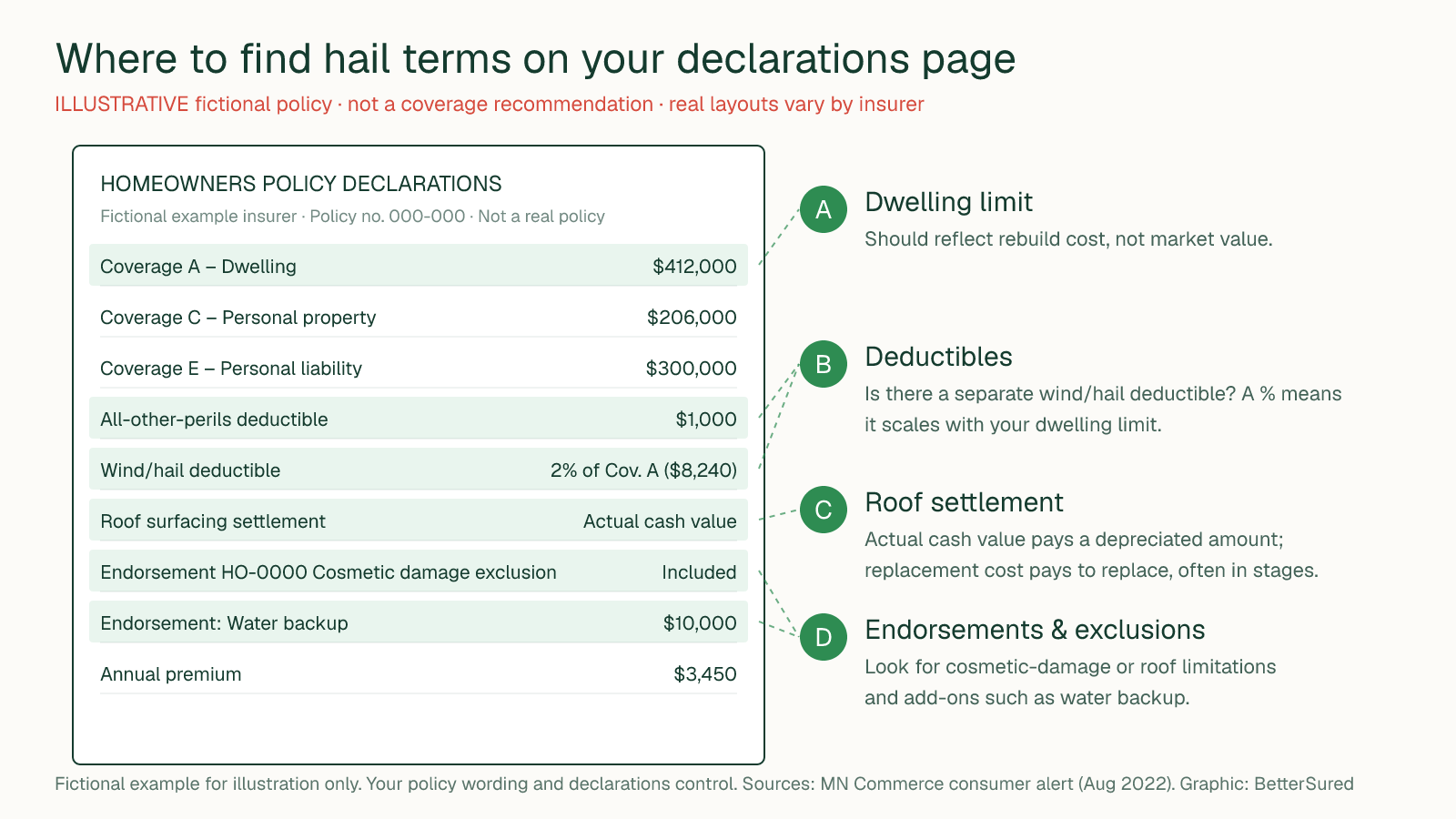
- Pull up your declarations page and look for the words "replacement cost," "actual cash value," or "ACV" beside your dwelling (Coverage A) and personal property (Coverage C).
- Check personal property separately — it is common to have RCV on the house but ACV on your belongings unless you added a replacement cost contents endorsement.
- Hunt for a roof surface payment schedule or ACV roof endorsement, especially if your roof is more than 10 to 15 years old. Insurers add these quietly at renewal.
- Confirm whether you carry extended or guaranteed replacement cost on the dwelling.
- Ask your agent to quote the RCV upgrade so you can weigh the roughly single-digit premium bump against the payout gap.
Working through a full homeowners insurance checklist makes it easy to catch these details in one sitting rather than one crisis.
Frequently asked questions
Is replacement cost or actual cash value better?
Replacement cost is better for most homeowners because it pays to replace items with new equivalents rather than their depreciated value. Actual cash value costs less up front but can leave you thousands short after a large claim.
Why is actual cash value coverage cheaper?
ACV is cheaper because the insurer's maximum exposure is lower — it never pays more than an item's depreciated value. You effectively self-insure the depreciation, which is why premiums run about 8% less on average than replacement cost coverage.
Why did my insurer put my roof on actual cash value?
Carriers increasingly move older roofs to an ACV basis to limit their exposure on a costly, high-claim component. If your roof is 15 to 20 years old, look for a roof payment schedule on your policy — it can dramatically reduce a storm payout.
Can I recover the withheld depreciation later?
With replacement cost coverage, often yes. Insurers commonly pay the depreciated amount first, then release the remaining "recoverable depreciation" once you complete the repair and submit receipts. Pure ACV policies do not offer this.
Can I switch from ACV to replacement cost coverage?
Usually, yes — ask your agent to add replacement cost coverage on the dwelling and a replacement cost endorsement on personal property at renewal. Expect a modest premium increase in exchange for substantially larger payouts.
The bottom line
Actual cash value and replacement cost describe the same house and the same belongings, but they can pay very different amounts when something goes wrong — and depreciation, especially on roofs and older possessions, is where the gap opens widest. For a single-digit bump in premium, replacement cost coverage often closes a five-figure hole. Pull your declarations page this week, check the settlement basis on both your dwelling and your contents, and if anything reads "ACV," take it as an invitation to give your property coverage a quick audit before the next storm does it for you.
Related guides
Water Damage vs. Flood Insurance: What Your Standard Home Policy Covers
Condo Insurance (HO-6) vs. HOA Master Policy: What Coverage Do You Actually Need?
Twin Cities Hail Damage: Check These Home Insurance Terms Before Storm Season
Condo and Townhome Insurance in Minnesota: What the Association Policy May Not Cover